Artificial intelligence ("AI") is a generational opportunity...
By that, I mean it's a disruptive technology. It will boost almost every part of the economy. And one day, our grandchildren will reflect on what's happening in real time right now.
It's a lot like Apple's (AAPL) iPhone, for example...
The first iPhone launched in June 2007. That was less than two decades ago. And yet, almost everyone walks around with a smartphone in their pocket these days.
The iPhone isn't the only tech to disrupt our daily lives, of course...
Major tech waves often follow a specific pattern of adoption. And right now, AI is about where the PC was in 1985...
Back then, a lot of people believed in the potential of PCs. But the machines simply weren't practical yet.
I worked as a technology analyst at the time. I vividly remember PCs sitting idle on many senior managers' desks – for years, in some cases.
Heck, even IBM's (IBM) CEO, John Akers, looked at an early model of the PC as just a toy. He didn't believe it could ever become a critical part of our everyday lives.
In hindsight... Akers was wrong.
It Pays to Catch Tech Cycles at the Right Time
The PC changed our lives long before we all carried smartphones in our pockets. It made things easier across all sorts of industries. And it combined with another disruptive force...
In the early 1990s, a lot of companies started shifting their focus to the Internet. They saw the technology's potential. So they invested time and money into it.
The Internet still wasn't practical at first. So the payoff didn't happen right away.
But here's the thing...
Investors who catch tech cycles at the right time can make massive returns.
After all, innovation always marches on. And the dot-com boom is proof. For example, look at what happened with Internet-related stocks – both over the short and long term...
According to FactSet data, the S&P Composite 1500 Internet Services & Infrastructure Subindustry Index produced a cumulative return of nearly 4,000% from 1995 to 2000. That performance crushed the benchmark S&P 500 Index's cumulative return in that span.
When we zoom out, the outperformance is even more impressive...
Even with the dot-com bust from 2000 to 2002, the S&P Composite 1500 Internet Services & Infrastructure Subindustry Index has produced a cumulative return of around 16,000% since 1995. That's more than 4 times the S&P 500's cumulative return over that period...
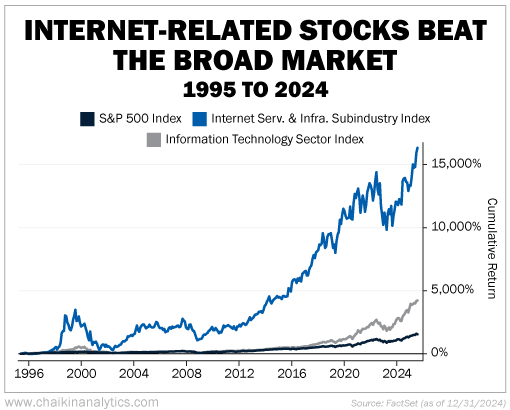
As you can see, buying into the broad-market indexes isn't always the right move. If you only do that, you'll often miss the biggest gains.
Sure, in a broad-market index, you'll get some exposure to the winners. But you'll also get exposure to companies that the innovation displaces or that decline for other reasons.
Not every Internet-related stock became a big winner. We've all heard of dot-com busts like Pets.com, eToys.com, and Webvan.
Here's where the hard part comes in...
The trick to successfully investing in disruptive technology is twofold. You need to find the big winners and avoid the big losers.
As you likely know by now, Marc Chaikin and I have put together a special presentation on this very topic. We've developed a new tool that helps us sort out the fakers from the real makers.
Later this morning, at 10 a.m. Eastern time, we'll be explaining exactly how it works. Plus, Marc and I will share the details on exactly where we believe you should move your money for the biggest potential gains this year... with the least amount of risk.
This event is free to attend. All you need to do is reserve your spot if you haven't already. You can do so by clicking here.
Good investing,
Joe Austin