Computers store data. They always have and always will.
But the Internet made a massive change. That's when the world realized data could be easily stored, retrieved, and even processed remotely.
And when you visit a website on a computer or open an app on your smartphone, you're seeing data retrieved from a different computer located far away.
For example, when you watch a movie on Netflix, it's being played remotely through the Internet.
Or when your iPhone keeps storing more and more of your photos and videos, these are uploaded to Apple's servers – ready to be accessed at any time.
But that's not the only way we generate data...
Think about the growing number of Internet-linked devices that we use on a day-to-day basis.
That includes things like smartwatches, wearable health trackers, voice-powered digital assistants like Alexa, and even electric vehicles like those from Tesla.
As long as we use these devices and they're connected to the Internet, they generate data. That data is then stored remotely in a data server. And it's ready for use at a moment's notice.
This is creating massive new demand that most investors simply aren't thinking about...
The chart below shows annual global data generation. It shows the amounts of data in zettabytes – each zettabyte equals 1 billion terabytes ("TB").
These are massive numbers. But the point is simple...
The amount of data created using all these devices and services has exploded over the years. Take a look...
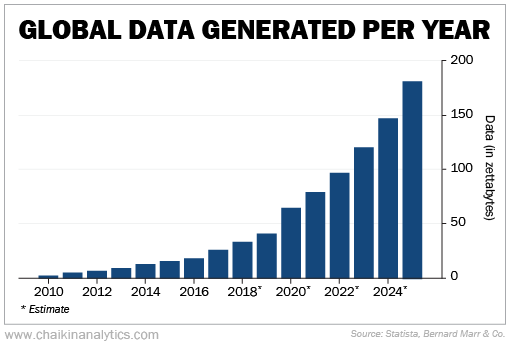
As you can see, global data generation grew from 2 zettabytes in 2010 to an estimated 120 zettabytes last year. That's a 60-fold increase in just 13 years.
And that's forecast to grow by another 50% by 2025, or by 60 zettabytes. That's more than all the data the world produced between 2010 to 2016.
And of course, we have to store that data where it can be easily retrieved and processed.
That means data centers.
In their simplest form, these are large groups of networked computer servers. They facilitate the remote storage, processing, and distribution of big amounts of data.
These networked servers live within buildings on "racks." These racks look like generic metal cabinets. But they're lit up like Christmas trees. And they run 24 hours a day, 7 days a week.
These racks can usually contain as many as 20 to 40 servers each. And each server can typically accommodate as much as 16 TB of storage. That means hundreds of TB worth of storage per rack.
With the average data center boasting an area of 100,000 square feet, it's capable of holding as many as 100,000 servers. That's like having a building with 100,000 computers running at the same time.
A data center this big would require 20 megawatts ("MW") of electricity to function. And that includes cooling, which accounts for the bulk of the consumption. Here's how it typically breaks down...
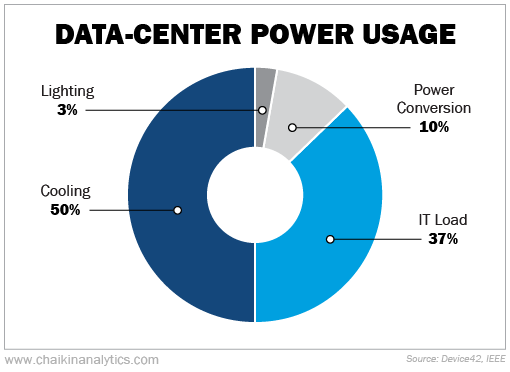
That 20 MW of energy is enough to power a small town.
Meanwhile, consider the largest U.S. data center...
It's owned by tech giant Meta Platforms (META) and is located in Oregon. The site covers 4.6 million square feet and consumes 982,177 megawatt-hours ("MWh") of power annually.
That's roughly 5 times the electricity demand of the average U.S. data center.
Meanwhile, these data centers are growing in size and capacity. And that's due to the boom in artificial-intelligence ("AI") use.
For example, a single query on so-called chatbot ChatGPT takes nearly 10 times the energy required for a simple Google search.
That's why U.S. data-center power demand is expected to reach 397 terawatt-hours ("TWh") by 2030. That would be a 172% increase over the next seven years.
It means that from just 2.5% last year, data centers will account for as much as 7.5% of total electricity consumption by 2030.
Folks, this is going to kick off major changes in America's energy sector.
Demand for data is booming. And by extension, so is demand for electricity.
If you're not paying attention to this trend now, I recommend you do.
Good investing,
Marc Chaikin
P.S. Amid all this need for electricity, I recently identified a way to take advantage in the latest monthly issue of my Power Gauge Report newsletter...
This business is providing stable, reliable electricity across the U.S. And it's the best-equipped company to keep the meters running and the lights on at America's growing number of data centers.
If you aren't already a Power Gauge Report subscriber, you can find out how to become one and gain access to this new recommendation by clicking here.