In terms of "gee whiz" discoveries, the biotechnology business is on fire...
For example, using a technology called CRISPR, scientists can edit DNA – like editing a Word document.
CRISPR cuts out faulty genes and pastes in corrected sequences. This means that, in cancer research, experiments that used to take years can get done in weeks or months.
Then there are bioengineered organs and tissues. Those are grown in labs using a patient's own cells as a start.
Since the starting cells originate from the patient, their body is less likely to reject the additions. Once a new organ is in, that can eliminate the need for lifelong immunosuppressant drug therapy.
Organs grown on demand could also help solve the massive organ shortage.
Every day in the U.S., about 17 people die waiting for an organ transplant. The waiting list for a liver transplant is now more than 10,000 people.
Additionally, consider bacterial therapy...
Scientists hack the E. coli bacteria living in your stomach and reprogram them to fight diseases. This has a wide range of applications – including cancer, inflammatory bowel disease, and Type 1 diabetes.
Put simply, it turns your stomach into a personalized, living drug factory that can target diseases more accurately than traditional medications.
The progress in biotech is incredible. And yet, broadly investing in biotech stocks has been a disaster in recent years...
The SPDR S&P Biotech Fund (XBI) is down about 39% from its high in early 2021. And over the past five years, XBI's annualized return came in at negative 2.7% versus 17.5% for the tech-heavy Nasdaq 100 Index.
That's massive underperformance.
Earlier this year, investment bank Jefferies looked at more than 360 public small- and mid-cap biotech companies. It found that on average, they traded at a mere 20% premium to the cash on their balance sheets.
Last year, that group traded at twice their levels of cash. And Jeffries also noted that over the past 23 years, the average was three to four times.
That means the market is assigning close to zero value to those companies' drug pipelines or research. It's viewing them as piggy banks... not businesses with potential.
The science marches ahead. But as a group, biotech stocks have struggled.
So... what's an investor to do? Let's take a deeper look today...
A Changing Landscape for Biotech
The real problem biotech investors face is that identifying success is still closer to guesswork than real analysis.
Only about 1 in 10 drugs that advance to clinical trials ends up getting approved. But approval alone isn't a guarantee that the drug will be a commercial success.
Companies are also facing increased competition from China. Research and development (R&D) costs in China are roughly a third of those in the U.S.
In 2024, Chinese companies logged more than 7,100 clinical trials with the World Health Organization. Meanwhile, U.S. companies logged about 6,000.
China has also shown that it can complete a clinical trial in 12 to 20 months. That compares with the global average of 24 to 36 months.
And by 2040, expectations are that China will account for 35% of approvals by the U.S. Food and Drug Administration. That's up from 5% today.
This is a fundamental shift in where drug innovation happens.
But competition aside, a strong supply-and-demand dynamic in biotech stocks is working in investors' favor...
There are fewer companies to buy at a time when Big Pharma has more money than ever to spend.
On the supply side, the initial public offering ("IPO") market for biotech has been near-dead for years. Only 18 companies went public last year. That's down from a pandemic-era peak of 150 companies in 2020 and 2021.
And this year hasn't been any better. Through mid-August, only 16 biotech companies went public.
Yet on the demand side, there's a ton of capacity with which to make acquisitions. Big pharma companies have an estimated more than $1.5 trillion in dry powder.
And they're faced with a "patent cliff" of about $400 billion between this year and 2033. To put that in perspective, the last big patent cliff for big pharma was around $250 billion in 2011.
So the question then becomes what to buy. Let's turn to the Power Gauge to help with the answer...
Separating the Potential Winners From the Losers
The first option would be to buy XBI. As an exchange-traded fund ("ETF"), it holds a basket of biotech stocks.
As I said earlier, the fund is down heavily from its 2021 highs. But take a look at it over the past 12 months...
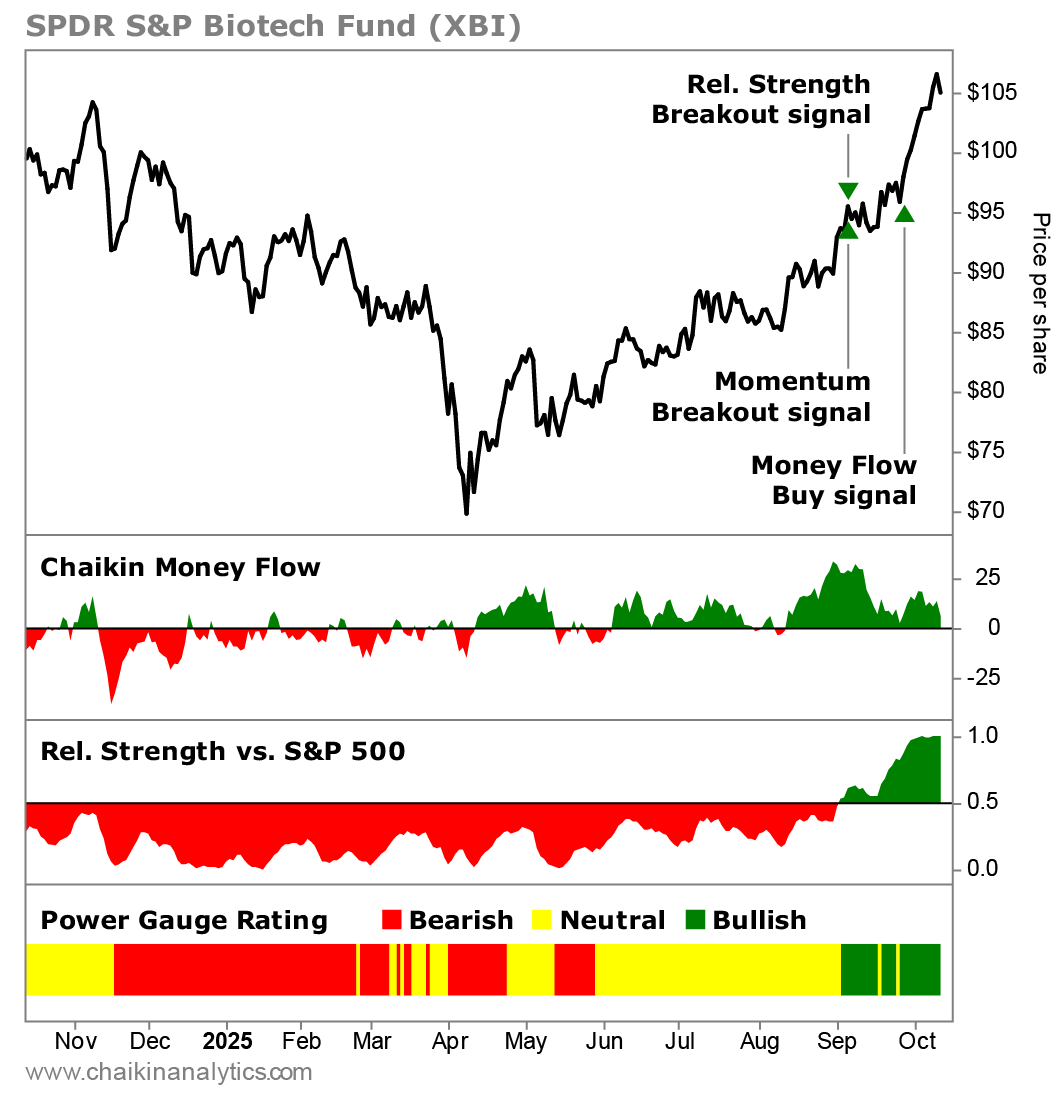
As you can see, XBI had still been sinking lower earlier this year. But since April, it has been moving higher.
In fact, for the first time in the past year, the Power Gauge turned "bullish" on XBI last month. And since then, our system has flashed three "buy" signals for the fund.
Another way to invest would be to buy an actively managed biotech ETF or mutual fund. That way (at least theoretically), you'll have an expert making educated guesses about what companies are worth owning.
There aren't a lot of these around. But as an example, the biggest one – the ARK Genomic Revolution Fund (ARKG) – currently earns a "bullish" rating from the Power Gauge as well.
Of course, you could also roll the dice and buy individual companies...
Right now, that doesn't look like a bad idea. The Power Gauge says the Biotechnology industry is "strong" right now. And it currently gives 205 stocks in the industry "bullish" or better ratings.
And within that, there are two ways to pick individual companies...
The first is to form your own opinion about a particular company's science and pick them based on that. But by doing so, you'll likely get drowned in a sea of knowledge pretty fast.
However, a second way is to look for companies selling at a discount or a slight premium to their cash.
In fact, this is something that big institutions do on a regular basis.
To do this, you need to find companies selling at a marginally positive or outright negative enterprise value ("EV"). To compute a company's enterprise value, add up its market cap and debt and then subtract cash and any short-term investments.
If a company has a negative EV, that means it's selling at a discount to its cash. And it means you're getting the company's science for free.
I recently dug into a list of U.S.-listed companies in the biotech sector. I calculated each company's EV... and found 83 companies selling for $0 or negative EV.
The Power Gauge doesn't publish a rating on all those companies. But of the ones with ratings, 33 were "bullish" or "better... 29 were in "neutral" territory... and only five were "bearish" or worse.
Now, it's important to note that the Power Gauge doesn't monitor what's going on with these companies from a science standpoint.
But it does look at relative strength and institutional money flow. As regular readers know, both these metrics are great indicators of what the "smart money" on Wall Street sees in these stocks.
So it could be useful in finding companies selling at deep discounts, too.
In the end, there's no requirement that an investor must have exposure to any one sector. That's true for biotech... just like everything else.
But at the same time, biotech is an industry that's hard to ignore. It's central to our future health and the economic competitiveness of our country.
The real challenge is investing in its potential without accepting those casino-like odds.
Good investing,
Joe Austin