Social unrest is an inherently tough topic...
It's political in nature. And it's usually connected to polarizing events.
So, folks, with that in mind, I apologize in advance for today's essay.
But as I'm sure you've seen by now, the mainstream media has focused on the protests in Los Angeles. The images are shocking.
The protests started in response to immigration raids. In response, President Donald Trump has called out the National Guard.
Put simply, things are getting ugly.
Here at the Chaikin PowerFeed, we don't get political.
But for many folks, regardless of political affiliation, it might feel like the world is unraveling. And that leads to fear about the markets.
Just last night, a close friend called me to express this fear. He worried that the markets would tumble... that social unrest would spread... and that we would see a collapse.
But history tells a different story. It's one that might surprise you.
So today, let's look at an example of recent social unrest. And we'll see how the market responded...
The Market Is Not Politics
On May 25, 2020, a Minneapolis police officer ended the life of George Floyd. The next day, folks started protesting in reaction. And the protests spread nationwide.
Many of these were peaceful. But in many other cases, they escalated into violence and destruction.
The Insurance Information Institute estimated that by June 8, the protests had caused as much as $2 billion in damages.
In monetary terms, that would make it the largest social unrest event in modern American history. The previous high mark was about $1.4 billion in damages. That was during the Los Angeles riots in 1992.
Folks, we aren't here to make a political comment on the George Floyd protests. I've also intentionally glossed over some of the details.
After all, they're highly politicized. And our focus is the markets.
But as I've said, the market response might surprise you. Take a look...
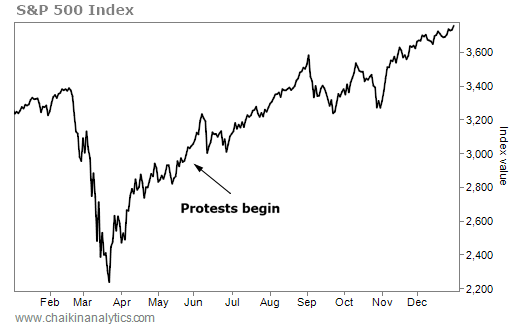
As the George Floyd protests gained steam, so did the S&P 500 Index. After all, this event happened well into the post-COVID-19 crash recovery.
And as we can see on the chart, the market found a peak on June 8.
During that short run, stocks gained roughly 8%. Think about that...
We're talking about one of the most extreme periods of social unrest America has seen. And while it was happening, the market ignored it.
Now, we can all see on the chart that the market gave back gains as June unfolded. But by the end of the year, the market had climbed more than 25% from when the protests started in late May.
To be clear, I'm not saying that social unrest is good for stocks...
Instead, I'm encouraging you to remember that politics is not the market. And the market is not politics.
Sure, they're interconnected – when it comes to significant financial outcomes for the broad market.
We've seen that play out with the recent tariffs... and their rollbacks. But a couple billions of dollars in property damage just isn't as big as it looks.
Today, the mainstream media has fixated on social unrest. And it feels like an all-encompassing event.
It's not. Events like these don't have a significant impact on the market until they alter consumer behavior.
Could that happen? Sure. But we're not there yet.
For now, what we're seeing is a sociopolitical event. Keep that in mind as you watch the news.
Good investing,
Vic Lederman