We're still moving through earnings season...
And a huge stock move in the wake of an earnings report recently caught my eye.
On October 29, financial-services firm Fiserv (FI) released its third-quarter earnings.
This is the company behind the Clover payment processor. Fiserv also serves banks and fintech businesses across the globe.
And the company's report shocked its investors...
In short, Fiserv missed its earnings-per-share ("EPS") estimates by a whopping 23%.
Leading up to the third-quarter earnings release, analysts had expected Fiserv's EPS to come in at about $10.16 in 2025. That estimate fell to $8.60 in the wake of the report.
And as I mentioned, investors were dismayed. After the earnings release, Fiserv's stock collapsed by a staggering 44% in a single day.
Multiple law firms are now investigating Fiserv for potential securities fraud.
One group has accused Fiserv of issuing "misleading and false statements." And it says that the company didn't disclose "information material to investors."
Another law group cited comments from Fiserv's CEO on the recent earnings call, who admitted that previously published forecasts would have been "objectively difficult to achieve."
It looks like Fiserv will have its work cut out for it in the coming years.
But this crash didn't have to catch investors off guard.
In fact, the Power Gauge was flashing caution on Fiserv long before the recent earnings report...
Warnings About Fiserv Throughout 2025
You see, earlier this year, Fiserv's stock was soaring. Then, on April 24, the company reported first-quarter earnings.
Fiserv's stock dropped more than 18% in the wake of the report. Its relative strength versus the S&P 500 Index collapsed. And the Power Gauge picked up on a retreat by the so-called "smart money" on Wall Street from the stock.
As you can see, our system quickly flagged a sell signal based on the breakdown in relative strength. Take a look...
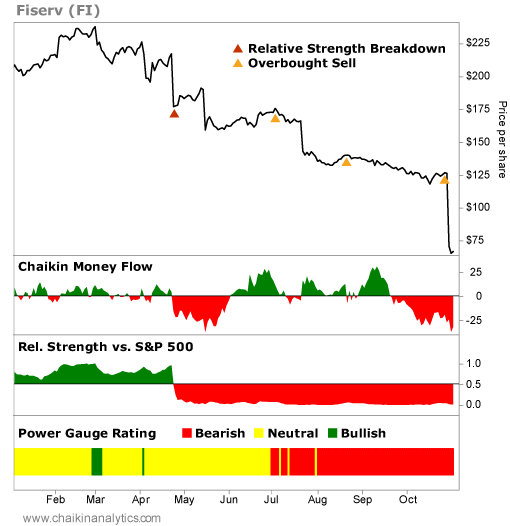
Let's say that you had poor timing buying Fiserv's stock – and you bought at the peak on March 3 for $237.79 per share.
If you had sold on April 25 when the Power Gauge issued its first sell signal, you would have "only" lost about 25%.
Sure, this wouldn't have been ideal...
But it's a better outcome than selling after the crash last week. From its peak in March to the market close on October 29, Fiserv fell about 70%.
And you'll notice in the chart above that the Power Gauge didn't stop flagging Fiserv after that sell signal in April. Our system issued three more sell signals before last week's crash.
That includes one on October 27... two days before Fiserv lost 44% of its value.
You Don't Need 'Magic' to Make Smart Investments
Folks, the Power Gauge isn't a crystal ball...
It's our powerful tool for detecting changes in a stock before it unravels. Put simply, it uses 20 individual factors to detect what's going on "under the hood."
And as regular readers know, our system turns that data into a single, actionable rating you can act on. These range from "very bearish" to "very bullish."
And with its range of alerts, the Power Gauge can flag specific signals that a stock is poised for more downside ahead – just like with Fiserv.
The Power Gauge has been clear on Fiserv in recent months. And today, the stock gets a "bearish" overall rating. So our system still sees more pain ahead.
I wouldn't be investing in Fiserv anytime soon. Instead, I'll be using the Power Gauge to find "bullish" opportunities.
Good investing,
Ethan Goldman
P.S. If you don't already have access to our one-of-a-kind system, you can get it by signing up for Marc Chaikin's Power Gauge Report newsletter...
As part of a special offer, it includes a full year of access to the Power Gauge and its ratings and data on more than 5,000 stocks. If you aren't already a Power Gauge Report subscriber, get the details on this offer here.