You've probably heard of the language learning platform Duolingo (DUOL)...
It started as an idea from a Carnegie Mellon University professor named Luis von Ahn and his student, Severin Hacker. Back in 2009, the pair had a unique idea for one of the Internet's problems...
Von Ahn wasn't a newcomer to the tech industry. He already sold two of his projects to Alphabet's (GOOGL) Google.
His first project was sold in 2005 and became "Google Image Labeler." The second was "reCAPTCHA," which sold in 2009.
Von Ahn saw how much time people spent answering CAPTCHA prompts on websites...
He realized that that time could be constructive. ReCAPTCHA protected websites from bots, while getting users to unknowingly help digitize books.
And Duolingo started with a similar concept...
The service would teach users a new language for free. In the meantime, those users would be helping to translate words and sentences on a website in a different language.
When Duolingo launched to the public in 2012, it was a hit. During beta testing, 500,000 people had already joined a waitlist to use the service.
By now, Duolingo has moved away from the website-translating angle. It's more focused on language learning.
And Duolingo's popularity continues today – particularly with younger folks. In its most recent earnings report, the company said it surpassed 50 million daily active users.
A user base like that sounds great. But that popularity hasn't saved the stock in recent months...
Today, Duolingo sits about 64% below its all-time high that it hit in May.
And instead of the earnings report with the user milestone triggering a surge for the stock, it only accelerated the slide.
Let's take a closer look today. And we'll see what the Power Gauge has to say, too...
Investors Demand More From Duolingo's Future
On the surface, Duolingo's growth looks strong...
For its third quarter, the company reported 34% year-over-year growth in its paid users. It also saw a 36% increase in its daily active users.
This helped the company grow its revenue by 41% year over year. It brought in nearly $272 million at a more than 72% margin.
Folks, those seem like great business fundamentals. But Duolingo's stock cratered by a staggering 25% the day after the earnings release.
Looking ahead, Duolingo projected its next-quarter revenue to only grow by about 30% to 32%.
And as CEO von Ahn noted in the report...
In Q3 we decided to shift the balance towards longer-term initiatives. In particular, we're investing proportionally more in teaching better, and we're prioritizing user growth over monetization in the A/B tests that get launched.
You might think this would assure investors about Duolingo's long-term staying power...
But the share price tells the opposite story.
Duolingo joins the ranks of data-analytics giant Palantir Technologies (PLTR) and social media titan Meta Platforms (META) to crash despite strong revenue gains.
The difference is that the Power Gauge signaled caution for Duolingo long before the third-quarter report...
Our System Has Been Flashing Warnings on Duolingo
As you can see in the chart below, the Power Gauge has rated Duolingo as "neutral" or worse since mid-June. And the Power Gauge issued four separate sell signals for the stock since then. Take a look...
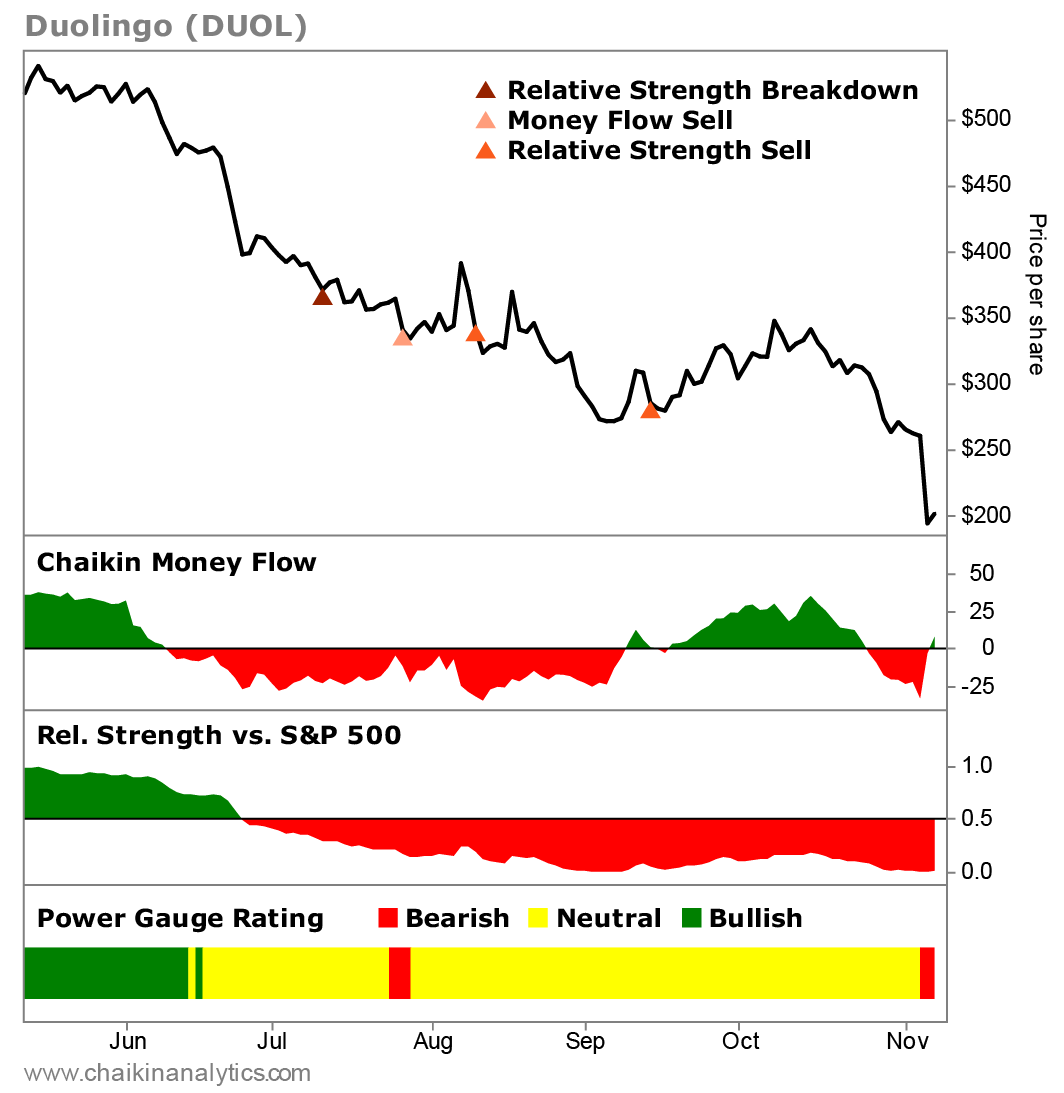
You'll also notice that Duolingo's Chaikin Money Flow support started disappearing in early June. This tracks the so-called "smart money" activity on Wall Street.
Shortly after that, Duolingo's relative strength versus the S&P 500 Index also turned negative.
The stock's technicals still look terrible. In fact, Duolingo's Technicals category in the Power Gauge is currently "bearish."
This is one of the four categories the Power Gauge uses to make up Duolingo's "very bearish" overall rating right now.
The Power Gauge tells us a clear story here...
Stay far away from Duolingo's stock.
Good investing,
Ethan Goldman