It has been the big topic in the media recently...
I'm talking about the government shutdown. It started earlier this week.
Unfortunately, the political brinkmanship surrounding shutdowns is nothing new. Politicians fight over who gets the blame. Government employees get furloughed. We see reductions in government services. And parks and museums close.
Most shutdowns have been relatively short. But the longest one lasted 35 days. It started in late December 2018 and dragged on throughout most of January 2019.
Of course, the media sounds the alarm when a shutdown happens – or when one is looming. We've seen that recently.
And for many folks, it can be a big deal. As I said, government employees get furloughed. And government services get disrupted.
But historically, the markets haven't responded like you might expect...
History Says the Markets 'Brush Off' a Shutdown
As regular readers know, we measure the broad market in the Power Gauge with the SPDR S&P 500 Fund (SPY). So let's look at SPY's performance during three of the longer shutdowns...
The first one we'll look at happened at the end of 1995. The shutdown began on December 16 that year and ended on January 6, 1996. It lasted for 21 days.
During this time while the markets were open, SPY barely budged. In fact, it lost less than half a percentage point in those three weeks...
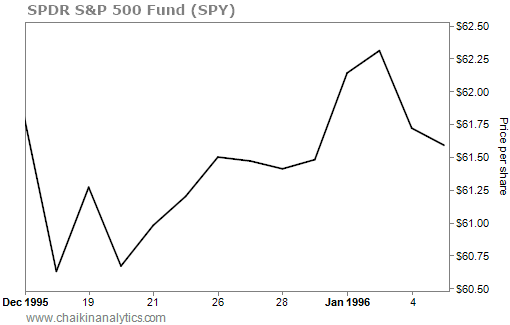
This is by no means an unusual chart. SPY didn't move more than 2% any day during this shutdown.
Moving on, another multiweek shutdown happened at the beginning of October 2013. It lasted 16 days. Over that time frame, SPY inched about 2% higher...
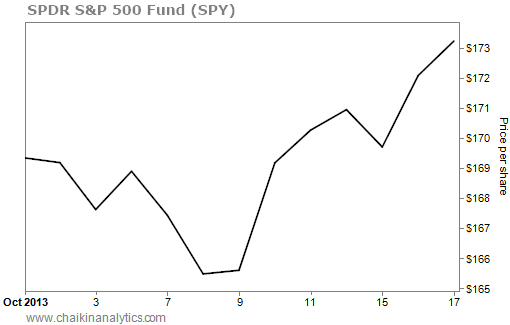
Again, this shutdown lasted just over two weeks. But the markets remained unfazed.
Finally, let's look at the longest shutdown in U.S. history...
It started on December 22, 2018. And as I mentioned earlier, it dragged on for more than a month.
Of course, when it started, nobody knew how long it would last. So considering how long it dragged out, you might expect the market to have collapsed.
But that didn't happen...
Amid the shutdown, SPY surged more than 10%. Take a look at the jump higher...
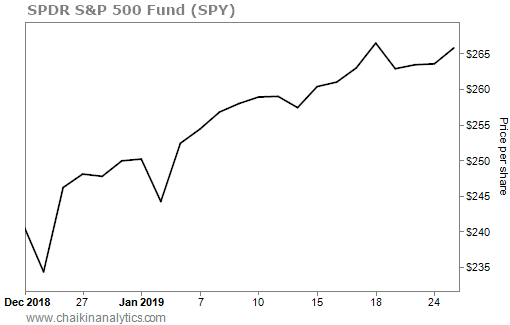
Put simply, that's an amazing gain for about a month's time. The average return for the S&P 500 is a bit more than 10% per year.
Back in April, my colleague Vic Lederman also noted another point in the aftermath of that record shutdown...
2019 turned out to be a massive year in the markets. The S&P 500 soared nearly 29%.
So the next time you see a scary headline about the government shutdown, pause for a moment. As Vic also said in April...
History tells us that these "market ending" events don't always play out like investors expect.
Sure, we're not that long into the shutdown. And we'll likely see some volatility.
But no matter where you stand on the political aisle, don't let your personal politics – or your emotions – take over your investing. The government shutdown isn't an automatic reason to panic.
Good investing,
Ethan Goldman